
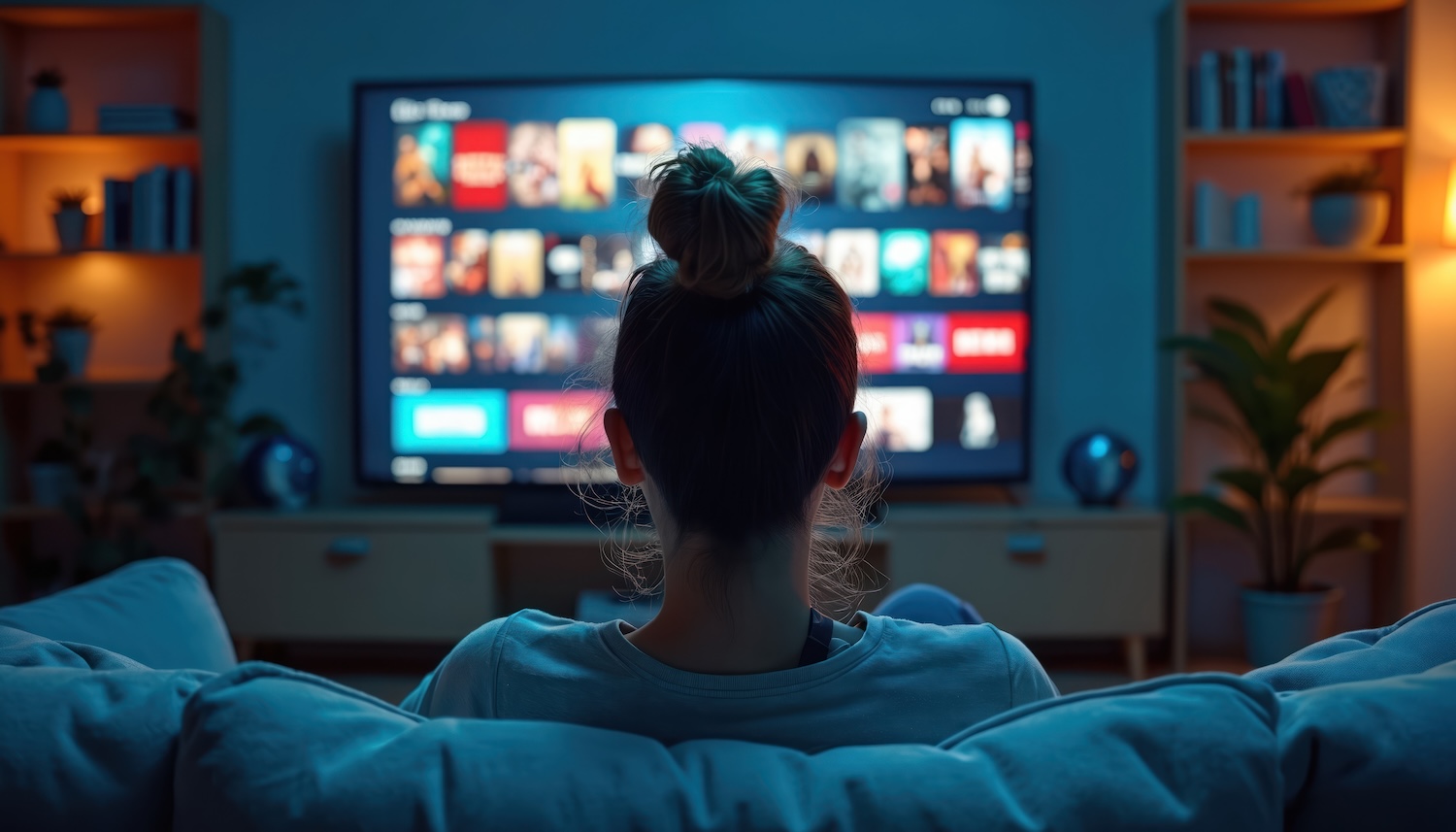
VOD advertising (video-on-demand advertising) is a similar advertising medium to TV and a way for brands to place video adverts within streamed, on-demand content. Rather than reaching people who are watching live-broadcast TV at a fixed time, VOD reaches viewers when they choose what to watch and when they watch it, across smart TVs, mobiles, tablets and laptops.
In practice, VOD adverts are served into the viewing experience, most commonly before the programme starts (pre-roll) or during natural breaks (mid-roll). Post-roll placements (after the content ends) exist too, but they tend to be less valuable as attention often drops once the main content finishes. Depending on the platform, viewers may not be able to skip the advert, which is one reason VOD is often considered a high-attention environment compared to some faster-scroll channels. Even so, attention is never guaranteed, so the first few seconds still matter.
If you are new to VOD, one of the tricky bits is that people use “VOD” as a catch-all term for several different things, so clarifying these different areas can help you plan, buy and measure more effectively.
The main types of VOD activity (and where your adverts can appear)
There are several types of on-demand video advertising.
AVOD (ad-supported video-on-demand)
The most common category you will hear is AVOD, which stands for ad-supported video-on-demand. This is free or cheaper content funded by adverts. AVOD can be a strong choice when you want reach and scale, and it is often used for awareness and consideration campaigns. Although very functional, it’s often seen as less premium compared to BVOD platforms.
BVOD (broadcaster video-on-demand)
You will also hear BVOD, or broadcaster video-on-demand. This is the on-demand content that traditional broadcasters provide through their streaming platforms. BVOD is usually treated as premium inventory because it sits alongside broadcast-quality programming, tends to have strong brand safety controls, and often feels like a “modern TV buy” with more targeting and reporting than traditional TV.
SVOD (subscription video-on-demand)
SVOD is subscription video-on-demand. Historically, SVOD platforms were ad-free, but many now offer ad-supported tiers. Where advertising is available, SVOD can be attractive because the content environment is typically high quality and engagement can be strong, although access may be more selective and costs can be higher.
Alongside those content categories, you will often see the terms CTV and OTT. These are not content types as such; they describe how the ad is delivered.
- CTV (connected TV) refers to adverts delivered to TV screens via internet-connected devices such as smart TVs, Fire TV, Apple TV, Chromecast and games consoles.
- OTT (over-the-top) refers to streaming delivered over the internet rather than through a traditional cable or satellite provider.
In day-to-day planning, people often use CTV as shorthand for “VOD on the TV screen”, even though many VOD campaigns also run across mobile and desktop.
Where do VOD adverts actually run?
Most plans use a mix of broadcaster streaming services, ad-supported streaming apps, and, in some cases, video platforms that are planned alongside VOD because the format and buying approach are similar.
Some campaigns are bought directly with media owners, while others are bought via programmatic platforms that provide access to multiple publishers in one place.
The right approach depends on your budget, your audience, how important premium content and brand safety are, and what level of reporting you need.
What VOD is used for, and what “success” looks like
VOD is most commonly used for awareness and consideration because it is a strong way to deliver a message in a TV-like viewing experience. If you need to introduce a brand, launch a product, explain a service, or shift perception, VOD can do a lot of the heavy lifting.
There is a common misconception that you need a significant budget for an effective VOD campaign. Of course, the more budget you have, the greater the reach of the audience and the higher the frequency of message delivery. However, smaller localised campaigns are also possible and can be very effective.
VOD can also support performance goals, but it is important to align expectations and measurement with how people actually watch. If someone sees your advert, they are unlikely to click there and then. Instead, VOD tends to influence outcomes that happen later, such as an uplift in branded search, more direct visits, improved conversion rates when VOD runs alongside paid search and paid social, and stronger performance from retargeting because the audience is “warmed up”.
A common mistake is treating VOD as a purely direct-response channel and judging it solely by click-through rate. That can lead you to undervalue it or to optimise in ways that reduce quality. A better way to think about it is as a channel that builds demand and intent, then works alongside other channels to capture that demand. However, this is also partly dependent on the creative messaging and promotional activity you want to push. It can be utilised as direct response, but you need to coordinate and align your audience, assets and goals to optimise performance and output.
Targeting basics (and why the planning details matter)
One of VOD’s big advantages over traditional TV is targeting. Options vary by platform, but often include:
- Geography
- Broad demographics
- Interest and behaviour-based segments
- Frequency controls (how often people see your advert)
Some platforms also support the use of first-party data, such as customer lists or website audiences, depending on their policies and available data connections.
The key planning challenge is balancing reach and precision. Too broad and you waste the budget on people unlikely to buy. Too narrow, and delivery can become inconsistent, costs can rise, and you may struggle to spend the budget efficiently.
This is also where placement quality and inventory choice matter. Not all “VOD” is equal. Two campaigns can have the same budget and targeting on paper, but deliver very different outcomes depending on where the adverts ran, how often people saw them, and whether the creative suited the viewing context.
Creative requirements: What you need to run VOD properly
Creative is often the difference between a VOD campaign that simply ran and one that genuinely worked. Beyond technical specs (which differ by platform), you should plan for a small set of standard lengths, typically 30 seconds and 15 seconds, and sometimes a 6-second cutdown to reinforce the message.
A sensible approach is to create a strong “hero” version, then produce cutdowns that keep the key branding and message intact, rather than trying to squeeze the whole story into a shorter edit.
From a messaging perspective, aim to capture attention early. Even when adverts are unskippable, viewers can still mentally tune out. Clear branding in the opening moments, a strong hook, and a simple message structure all help. It is also wise to design for partial attention. Many VOD environments are ‘sound-on’, but it is risky to rely solely on voiceover. On-screen text for key points and strong visuals that communicate the idea quickly tend to improve recall.
It also helps to keep each advert focused on one job. If you try to introduce the brand, list every benefit, include proof points, promote an offer, and push a call to action all in one, the result often feels rushed and forgettable. If you have multiple messages, it is often better to plan multiple creatives and sequence them or split the activity by objective.
Of course, if the campaign is intended to drive response, you need a strong call to action and promotion offer over brand-led messaging. Your call to action should match how people watch. On TV screens, “click now” is rarely realistic. CTAs like “Search for [Brand]”, “Visit [domain]”, or “Visit our local store” usually fit better, supported by memorable cues that make it easy for someone to act later. In environments where clicking is possible, you can be more direct, but it still needs to feel natural for the viewing behaviour.
Why experience often makes VOD campaigns more successful
VOD looks straightforward: pick a platform, pick an audience, upload a video, and press go. In reality, good outcomes often come from the less obvious decisions, such as how inventory is selected, how frequency is controlled, how audiences are sized, how creative is matched to placements, and how measurement is set up to reflect how VOD influences behaviour.
That is why specialist advice and experience often improve results. It is not just about buying media; it is about avoiding predictable pitfalls, setting up tests that actually teach you something, and optimising towards meaningful outcomes rather than the easiest metric to report on.
You can absolutely start without an expert, but if you want VOD to become a reliable growth lever, the planning and iteration usually benefit from someone who has seen what works across different brands and budgets.
Get to know Nick: Our in-house VOD expert with years of experience buying ad placements online.
Why VOD matters more now than ever
Television viewing habits have shifted permanently. Audiences are no longer tied to a schedule, and the living room screen is just as likely to be showing streamed content as it is a traditional broadcast. For brands, this means the premium, high-attention environment that TV has always offered is now accessible with far greater targeting precision, more flexible budgets, and much better measurement than a traditional TV buy ever allowed. VOD is not a replacement for TV – for many brands, it is simply becoming what TV looks like now.
Where to start
If you are new to VOD, it does not need to be complicated. A sensible starting point is to get three things clear before you spend anything:
- Objective first. Are you trying to build awareness, shift consideration, or support a specific campaign or promotion? This shapes everything from platform choice to creative approach.
- Audience second. Who are you trying to reach, and realistically, how large is that group? This will help you choose between broader AVOD reach and more targeted BVOD or SVOD environments.
- Budget third. You do not need a TV-sized budget to get started, but you do need enough to build meaningful frequency with your audience. A campaign spread too thinly across too many platforms rarely teaches you much.
Once those three are aligned, you are in a strong position to test, learn, and build from there.
Questions we get asked a lot
The Marketing Labs team fields a lot of questions about VOD from our clients. Here are the top three most frequently asked questions.
How much do I need to spend to test VOD properly?
There is no universal answer, but a meaningful test – one that gives you enough reach and frequency to actually measure an effect – typically requires more than most people initially assume. The exact figure depends on your audience size, geography, and platform mix. What we would say is that an underfunded test often produces inconclusive results, which can lead people to write off the channel unfairly.
Do I need a TV-quality production to run VOD ads?
Not necessarily. Production values matter, but clarity and branding matter more. An ad that communicates a single message confidently, with clear visuals and your brand present early, will outperform a glossy but unfocused one. If you already have video assets, it is often worth seeing what can be adapted before commissioning something new from scratch.
Can VOD work for a smaller or local business?
Yes, and this is one of the most underappreciated aspects of the channel. Geographic targeting lets you run campaigns focused on a specific region, city, or even a postcode area. VOD is no longer exclusively the territory of big national advertisers.