

Making small changes to your content can damage your site’s rankings, according to a major new study that tracked updates to thousands of URLs.
It comes as no surprise; it’s widely known that Google takes a very dim view of practices it considers manipulative, such as changing timestamps and making insignificant updates to content solely for ranking purposes.
“Besides spam, we also work hard to reduce low-quality content and ranking manipulations by fighting behaviours that attempt to narrowly avoid violating our quality guidelines but are still manipulative in nature and degrade the user experience.”
For a long time, the consensus was that fresh content equalled improved rankings – and that mantra has stuck. What this new study from RepublishAI shows is that making superficial updates to content can have the opposite effect, downgrading your pages in the SERPs.
Minor updates downgrade rankings
RepublishAI tracked content changes to 14,987 URLs across 20 sectors over almost three months to understand how these updates affected their position in the SERPs.
The results were astounding.
What they found was a strong correlation between the amount of content added and the page’s average ranking position.
Pages with ‘substantial content expansion’ saw ranking improvements – an average of 5.45 positions (8 positions more than the control group, which received no updates).
What’s more, minor changes to the page resulted in an average drop of 0.51 positions, and moderate changes saw an average drop of 2.18 positions.
In this context, ’substantial change’ refers to an expansion of the content by 31 – 100%. To put this into perspective, for a 1000-word article, you would need to add between 310 and 1000 words of new content to see a positive return.
Moderate changes refer to an expansion of 11 – 30%, and minor changes refer to 0-10% of content modifications.
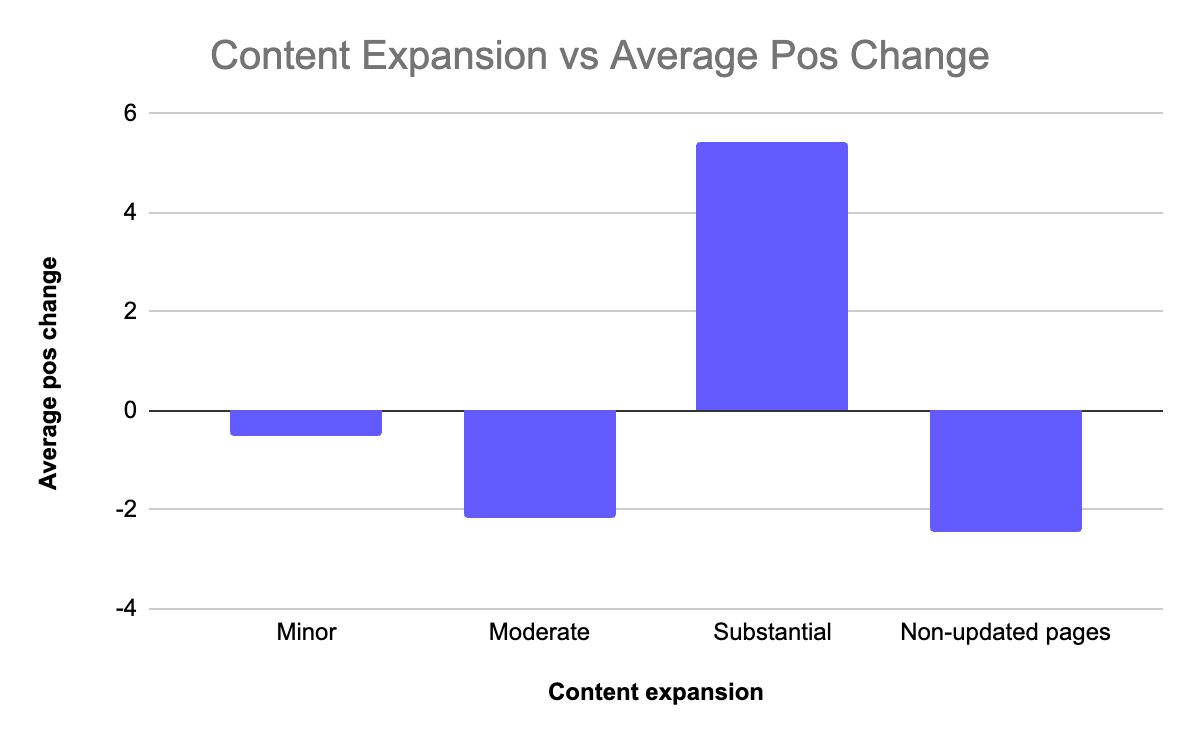
Data taken from RepublishAI’s study on 23 June, 2026.
The biggest gains are in the expansion of content by 31-100%. Which may lead you to the conclusion that unless you’re willing to make substantial changes, it’s better to just leave your content alone.
But this assumption would be incorrect, because the pages that weren’t updated at all (the control group) saw the biggest losses, with an average of -2.51 positions.
It seems the key to squeezing the biggest impact out of your content modifications is to find the sweet spot, which, according to this study, might be somewhere between 31% and 100% of additional content.
Content changes and their impact on rankings
Importantly, we should keep in mind that this is just one study. We can’t conclusively write off doing anything based on a single piece of research. But there are other generally accepted ‘SEO truths’ that might also add weight to the argument that making frequent minor changes can disrupt performance.
Frequent changes leave no time for testing
Making minor changes one after the other can make it difficult to understand which strategy worked. We suggest making changes to a page based on a single objective, recording the changes, then waiting to see what happens. Nothing in SEO happens quickly, so be prepared to leave a few months between updates for a stable data trend.
Uncoordinated updates lead to confused intent
Updating a piece of content without having a clear objective about what you want to achieve, or worse, a different objective than the one you had when you originally wrote the piece, can confuse Google and the reader. Making uncoordinated minor tweaks over time can result in a less cohesive piece that lacks direction and undermines your topical authority.
You may lose your historical rankings
Every time you update a page, you risk losing the hard-earned historical keyword rankings that you’ve already gained. Each content piece, if well prepared, is optimised for specific keyphrases and topics, and frequent changes may disrupt this optimisation, negatively impacting SEO performance. Especially where Google believes this to be manipulative.
Likewise, every change has the potential to introduce errors, from broken links to misspelt words.
What is a comma swap, and how to avoid it?
Updating something trivial on a page, like a comma or a full stop, to force an update of the timestamp is considered a misdemeanour by Google and can suppress rankings if you’re caught.
The phrase ‘comma swap’ originally referred to the swapping of a comma or a full stop in the page’s code, forcing the system to update the page’s timestamp and making it look like it’s fresher than it really is.
Today, ‘comma swap’ is used to refer to any small change made to a page that makes it artificially appear like it has been updated.
Original text:
‘There’s no such thing as bad publicity’ doesn’t apply when it comes to customer reviews.
New text:
‘All publicity is good publicity’ doesn’t apply when it comes to customer reviews.
Why it fails:
Simply replacing a few words with something similar but conveying the same sentiment isn’t enough to be considered a real change.
Google can compare two versions of a page – the live and historical versions. If it detects a change of date with no other text variance, your ranking positions are likely to be frozen, which will eventually lead to a loss of impressions and traffic as your competitors overtake you in the SERPs.
This is part of Google’s Fresh Content Patent, but this is just one of many signals that it uses to determine how substantially you have amended your content. Google also looks at user behaviour, your backlink profile, and how the content compares to your competitors, i.e. are you bringing anything new to the table?
Are any small content changes justified?
The evidence against making minor changes is mounting, leading to the obvious question: Is there ever a time when making a small change is justifiable?
There are some occasions when it’s required:
- The law has changed: A change to any legislation quoted in your content should be updated as soon as you’re made aware. Failure to update outdated legal references could negatively affect how your reader perceives you.
- Inaccurate information: Inaccuracies in your content can erode trust and undermine your brand’s credibility. Pricing changes, outdated product references, and typos are all examples of factual errors that should be corrected.
- Broken links: This is another example of a problem that should be corrected as soon as it’s identified. Broken links can affect the health of a page, so updating it is essential.
When you’re making these changes, there are some things you can do to avoid potential penalties from Google:
- Allow the CMS to deal with the modified date change without making any front-end changes to the publication date that could be viewed as an attempt at manipulation.
- If you are worried about being scrutinised by Google, leave the published date as the original date and add a small footnote to the content that outlines the change, e.g. ‘This article was updated on 22 June 2026 to reflect a change in the price of some of our products.’
For every piece of content that you change, ask yourself: What am I making this change for? If the answer is simply to improve your rankings, then stop. If Google detects that this is your intention, you could be penalised.
However, if you’re making a change to improve the content for the reader by adding real value, then the likelihood is your updates will be viewed favourably.
As always, having good intentions is important. But is it enough? If you notice an immediate drop in rankings after you’ve made the changes, stand firm. This is likely a tactic by Google to weed out spammers.
Google’s Rank-Modifying Spamming Patent
Google has set a trap to identify and penalise spammers attempting to ‘game’ the system using manipulative tactics.
It’s known as the ‘Rank-Modifying Spamming Patent’, and it works like this (put very simply):
- You make changes to your site, and Google detects these modifications
- In response, Google may temporarily adjust your ranking positions, often resulting in a noticeable change, such as a steep drop.
- A spammer sees the sudden change and quickly modifies the page, undoing any changes they made in an attempt to reverse the effect.
- Google anticipates this reaction, reinforcing its suspicion that the modifications were an attempt to manipulate rankings.
- As a result, Google may impose penalties on the site.
Mark Williams-Cook, SEO and AI-search professional, recommends standing firm. If your changes are grounded in making genuine improvements for the reader, then hold your line.
As Mark says, “sometimes things get worse before they get better”.
A final thought from Marketing Labs
Typically, when a client of ours makes changes to their website, they are doing it with the best of intentions. But this is little comfort when the results are not as expected (or worse).
To really move the needle in your favour, you have to substantially expand the word count, but more than this, you also have to add value. If Google compares your content to what’s already out there and it finds it’s no different, then there’s little point in adding it to the first page of results.
As Google works harder to remove redundancy from its search results, content marketers need to work harder to produce original content that brings something genuinely new to the table. Now more than ever, with the advent of AI, this should be our priority.