

‘There’s no such thing as bad publicity’ doesn’t apply when it comes to customer reviews. A few lines of negative feedback from your customers can sow doubt in your prospects’ minds. A fact that has led some companies to try to game the system.
AutoTrader, Dignity, Feefo, and Just Eat are all being investigated by the Competition and Markets Authority (CMA) for allegedly manipulating the customer review system. If found guilty, these companies face fines equal to a percentage of their turnover, not to speak of the reputational fallout.
It seems obvious to point out, but it’s not worth undermining good customer reviews by pretending bad reviews don’t happen in the real world. So, what’s the right way to do it, and how can you avoid the common pitfalls?
How much do reviews influence the buying decision?
Let’s start with some facts that add context to the customer reviews discussion:
- 97% of consumers read reviews for local businesses (BrightLocal)
- Positive reviews are one of the top three purchase influencers for 49% of global consumers (Trustpilot)
- Just over half (52%) of consumers think having no negative reviews is suspicious (Feefo)
- 47% believe that a company should always respond to negative reviews (Feefo)
- 69% would continue to make a purchase if they could see that the business had acknowledged or responded to negative reviews (Feefo)
These statistics tell a story that we should be mindful of as digital marketers. While positive reviews undoubtedly have great sway over purchase decisions, how you handle negative reviews is equally important.
Open vs closed review platforms
Open review platforms allow anyone to leave a review, regardless of whether they’ve had a genuine direct interaction with a business. Platforms such as Google and Facebook use an open model, which can lead to a mix of reviews.
These platforms make it easier for customers to leave feedback freely – they’re familiar and easy to use – but they’re harder to moderate. Unfair or inaccurate reviews are difficult (but not impossible) to remove without proof that they’re erroneous.
Closed review platforms have measures in place to ensure that only genuine customers can leave feedback. TripAdvisor, Feefo and Trustpilot are examples of closed review platforms. Figures suggest that closed sites are considered more trustworthy for authentic reviews, but that comes at a cost.
These sites typically operate on a subscription-based model, in which businesses pay a fee to access the service. This fee structure can vary significantly based on the platform’s features and the scale of use.
Ultimately, choosing between the review sites comes down to industry, location, budget and what you want from it. Yelp, for example, is popular in the US, while TripAdvisor is unique to the hospitality and travel sector, and G2 is best for SaaS businesses.
Tips for collecting customer reviews
Prospective buyers are only likely to consider reviews from the past three months – and one or two reviews isn’t enough. Having a steady stream of new customer reviews reassures people that you are a reputable business.
“Online shoppers can’t physically walk into your store and see other customers browsing and buying. That real-world social proof – the busy coffee shop, the queue at the till – simply doesn’t exist in the same way online. Reviews fill that gap. Customers are far more likely to purchase if they can read that others have already converted,” says Marketing Labs’ CEO, Matt Janway.
Leaving it to chance, hoping that customers will organically leave a review without being asked, isn’t enough. In reality, most won’t do this. By adding review-collection to your workflow, you can ensure it’s not overlooked.
Top tips for encouraging the collection of reviews:
- Just ask: By not asking, you’re leaving money on the table. You’d be surprised how well customers respond to a polite request for a review after they’ve bought a product or service.
- Add it to your email sequence: If you use a CRM, include an automated request for a review so it arrives just after the customer’s experience – timing is everything.
- Make it easy: Provide direct links to the review platforms where you want customers to leave feedback. Simplifying the process reduces friction, increasing the likelihood that customers will follow up.
- Follow-up: Send a gentle reminder to customers who haven’t left a review. A friendly follow-up can serve as a nudge, reminding them how important their feedback is to your business.
- Personalise your request: Your customers are far more likely to leave a review if your request feels more like a personal message than a mailshot sent to thousands of customers at once.
Make your reviews more meaningful for buyers by extracting valuable feedback from your customers. Generic, vague testimonials don’t say anything about your business: ‘Five-star, would recommend’ (you know the type of thing). And because they’re easy to fake, they’re much less likely to be believed.
“When reaching out to customers, suggest specific topics you’d like them to address – the product quality, their on-site experience, or interactions with your customer service team. This is more likely to provide buyers with something useful when they’re comparing products and services,” adds Matt.
Are fake reviews a big problem?
Just over half of all online reviews (50.15%) have traits that make them appear suspicious, according to an in-depth study by TruthEngine. Even when they’re written by a real person, consumer reviews are still open to manipulation.
Take Pasta Evangelists, for example. They’re being investigated by the CMA for allegedly offering incentives in exchange for 5-star reviews. Offering your customers incentives in exchange for leaving a review may seem innocent enough, but it violates the policies of platforms like Google.
Offering incentives can lead to artificially inflated, biased, or dishonest reviews. As it’s not a true reflection of the customer experience, it’s considered misleading and undermines the review system as a whole.
Avoiding the pitfalls that could land you in trouble
As in the Pasta Evangelists example above, there are things that could land you in trouble. Avoid these common review pitfalls:
- Asking staff to leave reviews: It’s tempting to ask staff to leave reviews, especially when you’re just starting out, but doing so risks undermining the genuine reviews you do have. Generic staff reviews are unlikely to add value and, worse, they contravene platform policies.
- Handpicking customers to ask for reviews: Soliciting reviews from customers you know are likely to say something positive can be seen as manipulative and may lead to penalties from review platforms like Google.
- Suppressing negative reviews: Quashing bad reviews is just as bad as soliciting only good ones. If it’s erroneous, you have a case to ask that it be removed, but genuine feedback should be taken for what it is: constructive criticism that can help you improve.
- Focusing only on quantity: Don’t see review collection as a target to hit, as this will lead to a collection of generic one-liners. Focus on securing authentic reviews that provide valuable insight into customer experiences.
How to deal with bad reviews
Having a collection of diverse reviews proves you’re a genuine business with real customers, which adds to the authenticity of what you’re trying to do. But it inevitably means you have to deal with both positive and negative feedback.
Every piece of feedback represents a real customer experience, even if you don’t agree with it. And crucially, how you respond says a lot about your business. Onlookers will be waiting to see how you move the conversation forward.
Respond to every review promptly
You wouldn’t ignore the phone if it were ringing, so don’t leave your customer hanging. If you leave it too long, you’ll lose the opportunity to put things right and show your market that you take feedback seriously. Imagine how many people will have already seen the review before you get to it.
Approach the reviewer professionally
It’s easy to take reviews personally, but recognise that the person leaving the review may be feeling frustrated or disappointed. Validate their feelings by expressing understanding and offering to resolve the situation with them directly. Continuing the conversation offline can help de-escalate the situation and foster a more constructive dialogue.
Embrace three and four-star reviews
Three and four-star reviews should play an important role in your review strategy. Fake or malicious ratings are typically at the extreme ends of the scale, so these middle-of-the-road reviews help provide authenticity and balance. A handful will help instil trust in your feed, bolstering the really stand-out feedback you get.
Learn and improve
Negative reviews often contain valuable feedback that can help you improve. Analyse the feedback to identify any patterns or recurring issues. Where possible, implement changes and let your customers know what you’ve done, as this will reassure them that you take their feedback seriously.
How do reviews feed into search and AI recommendations?
Reviews are not just about converting prospects; they also help people find you in the first place so that you can be part of the consideration phase.
Reviews have always been an important part of the marketing mix, but with the rapid uptake of AI, their influence is now more far-reaching than ever. You can expect to see them in Google’s AI overviews and ChatGPT query responses (other LLMs are available!).
40% of consumers trust AI platforms to provide business recommendations (BrightLocal).
A quick search for the best places to get coffee in Sheffield pulls in user-generated content and reviews from Reddit, TripAdvisor, and Google’s own Business Profiles for local cafes.
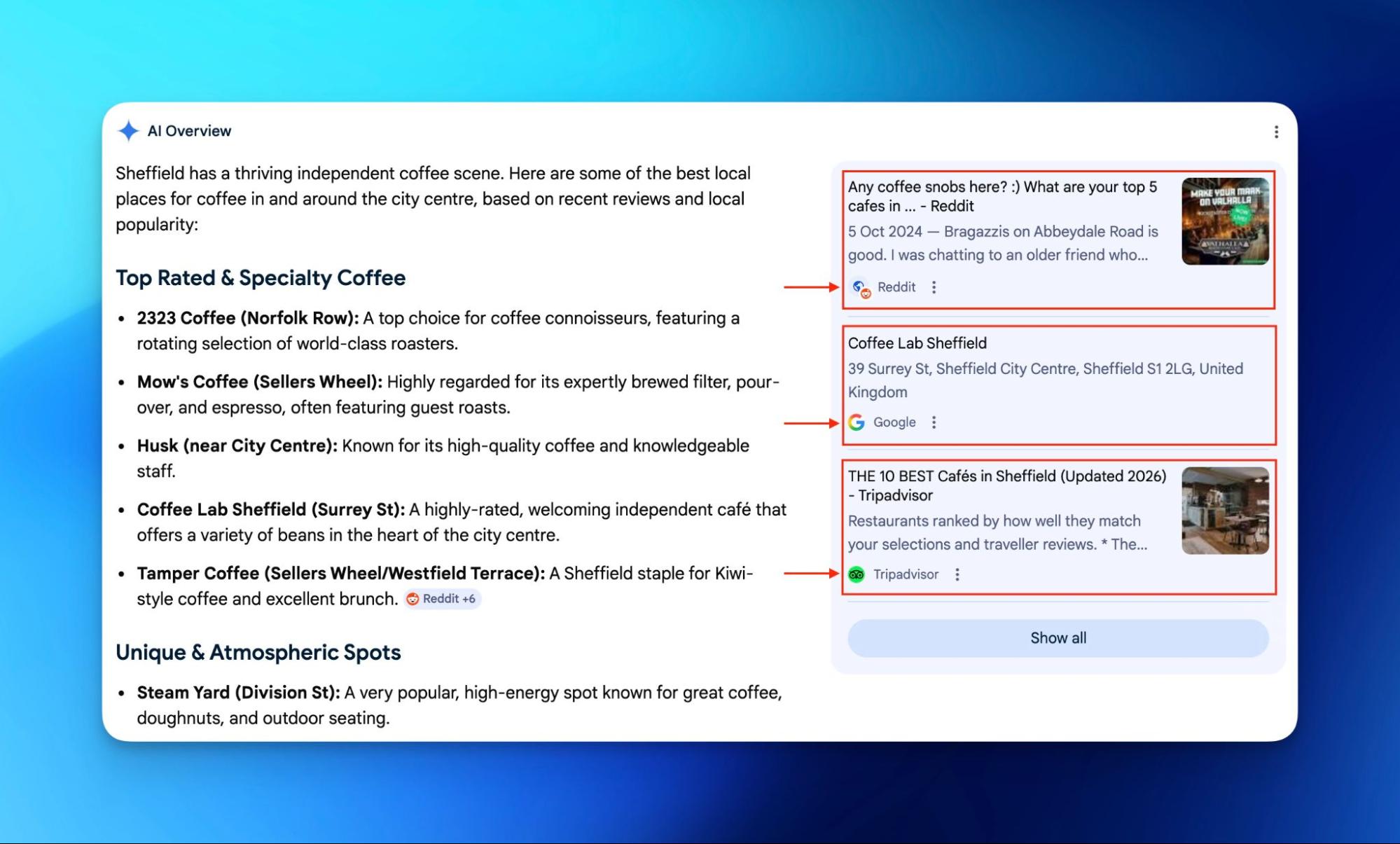
And it’s not just service businesses. Ecommerce sites, bricks-and-mortar stores, and SaaS companies are all in a similar boat.
Reviews also have an impact on other aspects of SEO – consider these key points:
- They’re keyword-rich: Customer reviews are naturally rich in keywords that people use to search for your product. Using these reviews on your website will help search engines find you.
- They’re great for research: Reviews provide a valuable insight into how consumers talk about your product/service. This is a gold mine that can supplement your own keyword research.
- They improve your rankings: Google rewards trustworthiness, and a steady stream of genuine reviews is one of the clearest signals of that.
So it’s clear that managing your reviews is more important than ever. Putting them front and centre is a sound business decision, but how do you do it? Next up, we cover technical best practices for embedding them on your site.
Technical best practices for using reviews
Reviews are an important trust signal and crucial to converting visitors into customers, which is why they’re a staple on most high-functioning websites.
Your homepage, landing pages, product pages, and key service pages are all places on your website where your customers expect to see reviews. Make it easy for them by having them front and centre, and pro tip, don’t force visitors to click off to a third-party site to read your reviews.
Josh Stapleton, CTO at Marketing Labs, shares his best practices for embedding reviews on your website.
1. API platforms over widget-only ones
Focus on API-first platforms over “widget-only” ones, says Josh. Developers need flexibility to pull data without slowing down the site. Widgets are render-blocking. They load external scripts that slow down the page, hurting Core Web Vitals (a potential ranking factor for Google).
An API pulls reviews into your CMS (e.g., Contentful, Sanity, WordPress) once per hour every day and serves them as static HTML. The page loads instantly, and search engines can “read” the review text as part of your content, which is a massive SEO boost.
2. Implement schema on product pages
Amplify your reviews by using schema on your ecommerce product pages (WooCommerce, Shopify, etc).
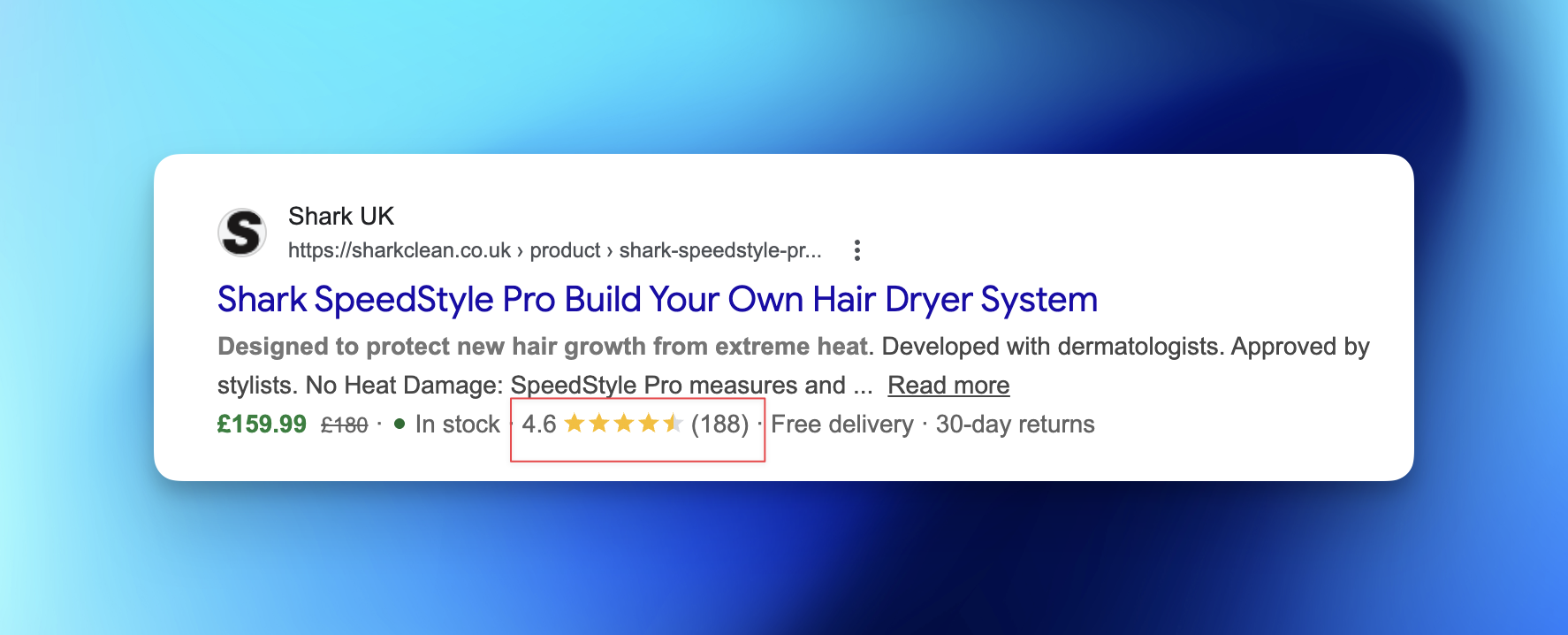
‘Review schema’ is structured data markup that helps search engines like Google understand and display product and service reviews. Adding schema provides Google with the information it needs to create rich snippets that include star ratings, as in the example from Shark below.
PRO TIP: You must nest your Review or AggregateRating schema inside a Product schema.
3. Self-serving review schema
When a business controls the reviews displayed on its own website, the star ratings from these reviews are considered “self-serving.” As a result, they are generally ineligible for display in rich results on search engine results pages (SERPs) for brands.
To enhance credibility and improve visibility, businesses can use the sameAs property within their Organisation or LocalBusiness schema to link to official profiles on reputable third-party sites (such as Yelp, TripAdvisor, or Google My Business).
While this approach won’t enable star ratings in organic search results, it can strengthen your Knowledge Panel (the information box on the right side of search results) and improve your ranking in the Local Pack (the map section), where Google may display your aggregate rating from trusted sources.
Review schema still works for other types, such as Product, Book, or Course, provided the reviews are independent and authentic.
Utilising reviews across the marketing mix
Customer reviews are versatile enough to be used across social media, display ads, PPC (pay-per-click), TV, radio, and printed materials.
Don’t just stop at ratings and reviews – consider creating testimonials and case studies that focus on aspects of your business you’d like to showcase. While reviews are great, they don’t always capture what you want to say.
Consider interviewing your best customers or asking them for a quote. This can be in written form, as a video, or as an audio clip. Consider how you’ll use it (and specifically, how you’ll share it) before you pick a medium.
Case studies and testimonials make great website content, and they can be shared on your social channels in smaller, bite-sized chunks. At Marketing Labs, we use testimonials on our website, but we also send out copies to our list of prospective clients.
Monitoring your online reviews at scale
When you’re just starting out, it’s possible to monitor your reviews manually as they trickle in slowly. But as your business grows, keeping up with new reviews in a timely way can quickly become unwieldy, especially where they are spread across several platforms.
To help you, there are lots of AI tools and platforms out there that will unify your star ratings and aggregate them into a single source of truth. While it’s tempting to just look at average ratings, it’s equally important to consider the sentiment of qualitative feedback. This is where you’ll find suggestions on how to improve customer loyalty.
Use AI to help you identify and analyse trends in your customer feedback, remembering that the most frequent comments aren’t always the ones affecting loyalty.
Final thoughts
Genuine customer reviews are crucial for building trust and influencing purchasing decisions. By focusing on transparency, encouraging authentic feedback, and responding to reviews, companies can enhance their credibility and ultimately drive sales. As the influence of reviews continues to grow, especially in the context of AI, managing them effectively is no longer optional but essential for success.